Gathering Gil Brewer
featuring "Mow the Green Grass"

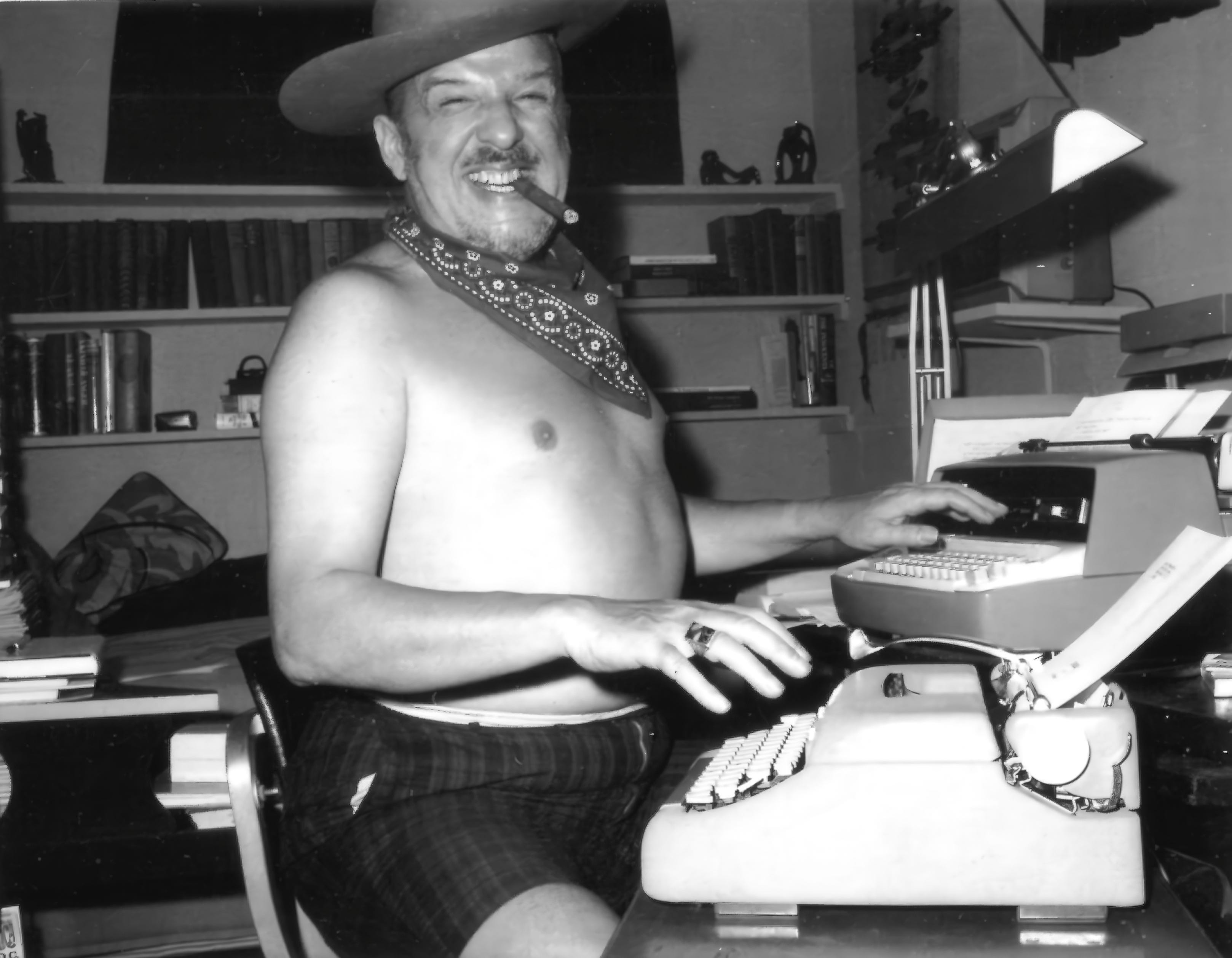
Gil Brewer in action. (from the Gil Brewer Collection, American Heritage Center, University of Wyoming)
In the late 2000s, I decided to edit the first collection of short stories by 1950s noir writer Gil Brewer. Fortunately, like most noir writers of his day, Brewer did not bother renewing the copyrights for his stories, so I would not have to pay to reprint them. Instead, my expenses would come from acquiring copies of the stories in the first place.
I began by cobbling together the best bibliography that I could from available resources, and then I bought everything I could find for sale online. (Sadly, the January 1956 issue of Accused Detective Story Magazine is not the sort of thing that you can get through interlibrary loan.) My most important resource, of course, was eBay. After a year of monitoring the auction site, I was confident that I would find copies of everything eventually. I just had to stay vigilant and be patient.
But there was a catch. To get copies of all of Gil Brewer’s stories, first I had to know what they all were, and I was certain that I did not know. Many of his stories were published under pseudonyms, and several of these names were not used exclusively by him, so pinning down a definitive bibliography was impossible—or at least it was impossible while sitting in front of my computer in Virginia.
All the answers, I hoped, could be found in the Gil Brewer Collection at the American Heritage Center at the University of Wyoming in Laramie. Brewer’s papers had never been organized or cataloged in a meaningful way, so it was impossible to know exactly what was there without visiting in person. I made my first trip in March 2011, and it was everything I hoped it would be. My most important discovery was a log of Brewer’s writing activities that covered most of 1955 and 1956, which were his two most important years as a story writer. From this, I was able to sort out the pseudonyms and identify several previously unknown stories by him. As well, I discovered that one story that had been reprinted in 2008 as by Gil Brewer (“Dig That Crazy Corpse”) was not by him after all.
I now had more things to find and buy, but I had also discovered that I already owned more Brewer stories than I knew. For example, I owned a copy of the March 1956 issue of Pursuit Detective Story Magazine because it contained Brewer’s story “Home-Again Blues,” published as by Eric Fitzgerald, and I was thrilled to discover the existence of a second Brewer story in that issue, “Mow the Green Grass,” published as by Jack Holland. That felt like money saved! Eventually, I did find copies of everything, and the total cost was about $1500.
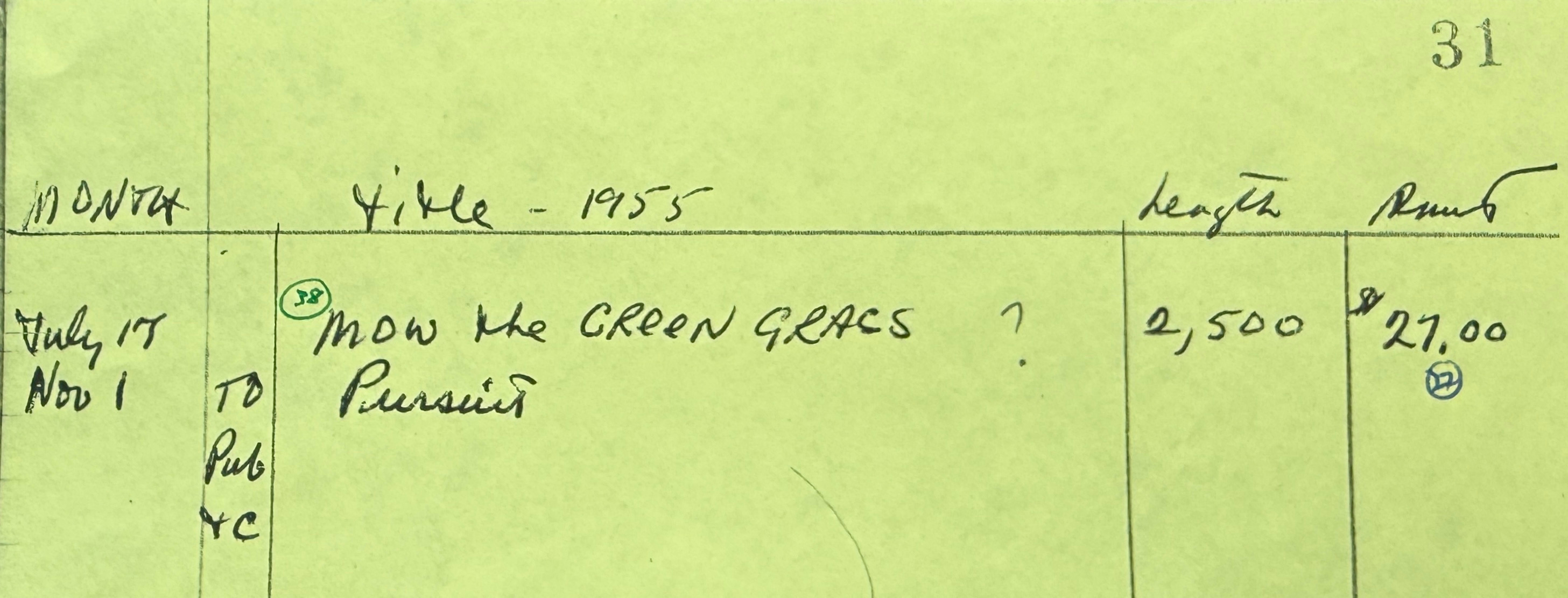
This image is from my photocopy of Gil Brewer’s writing log. (At the American Heritage Center, photocopiers are stocked with yellow paper to make it easy to differentiate between copies and originals.) Three marks in the image are not Brewer’s: the circled numbers (38 and 27) are me counting things, and the penciled question mark is me asking myself, “Wait!!! What story is this???”
Back home in Virginia, I went to my favorite coffee shop to read “Mow the Green Grass” for the first time. Business at the coffee shop was slow, and I was sitting alone in the back room. “Mow the Green Grass” features one of Brewer’s favorite subjects: manhood under threat. As the end of the story approached, I sensed where it was going, and I began to rise out of my chair. When the ending happened, I jumped out of my chair, and it flipped over backwards with a clatter that echoed in the empty room. This is, I am certain, the only time that I have ever flipped over a piece of furniture as the result of reading a short story.
Mow the Green Grass
Gil Brewer
The tall puffy-eyed man yawned and shuffled across the living room into the kitchen and sprawled in a chair at the table. He wore wrinkled blue and white striped pajamas and bedroom slippers. His hair stood on end.
“Morning,” the young woman by the stove said. “You finally up?”
“It’s Saturday, Jane, for cripe’s sake! You know that. What time is it?”
“Nearly ten.”
He looked at her blearily. She was a well-stacked young woman wearing a thin white blouse neatly tucked into the slim waistband of her tight, rolled red shorts. Her legs were very long and brown and well-formed, her hair very blonde, her eyes very bright and clear blue.
He stared at the table. “Where’s my coffee?”
She glanced at him, then stuck the tip of her pink tongue out at the back of his head. “Coming, dear,” she said. She leaned sideways and used both hands to fasten the zipper on her shorts up over her hips to the waist. She buttoned the small flap over the zipper top, ran her hands through her hair, glanced at the kitchen door, then picked up the coffee pot. “That all you want this morning?” she asked. “Coffee?”
“Oh, hell,” the man said. “Pour it!”
She poured his coffee. Somebody knocked at the side door. She returned to the stove, put down the coffee pot, and went to the sink.
“Answer the door!” the man said.
“Don’t shout, Harley,” she said quietly, moving to the door.
Harley muttered something and spooned sugar into his cup. Jane opened the door. “Oh,” she said. “Hi, George.” She turned and glanced at Harley. “It’s George.”
Harley grunted and sipped hot coffee. Not bothering to look up, he missed the way Jane looked at the lean, dark-haired man by the door. She pushed her red lips out and winked at George and George looked at her legs, then winked at her. She moved a hair’s breadth toward him and he leaned his hand against the doorframe so his fingers touched her hip. She moved her hip faintly against the tips of his fingers. Her back was to her husband.
“Wondered if I could borrow your gasoline mower?” George said. He was wearing khaki shorts and a T-shirt. “Gotta get at my lawn.” He turned and craned his neck toward the house next door, looking at the grass.
Harley looked up quickly, nearly over-turned his coffee. He stared at the table and grimaced behind his hand.
“George wants to borrow the lawn mower,” Jane said.
“Sure,” Harley said. “Sure, go ahead.” He spoke in a curiously choked manner and his face was pale.
“Thanks, Harl,” George said, craning his head toward the kitchen so his ear touched Jane’s arm. “Thanks a lot. Having coffee?”
“Uh-huh.”
George sniffed and grinned.
“Come on in and have some,” Jane said. “I made plenty. Harley guzzles it all day, you know.”
George laughed and stepped into the kitchen, brushing against Jane. Jane lightly leaned against him as she turned and moved to the stove.
“Well, well,” George said, standing there exuding sweat and brawn. “I been up for hours. Had breakfast at seven. I could go a slug of java.”
Harley looked up and nodded.
George slumped into a chair at the opposite end of the table, glanced at Harley. Harley was staring at his half-empty coffee cup. George looked at Jane’s legs, caught her eye.
Jane chuckled and poured him some coffee. When she placed his cup in front of him, she rested her hand on the back of his chair so her fingers lay against his right shoulder, and her knee bumped his leg once.
Then she returned to the sink and began washing dishes.
“Hot as hell out,” George said. He drank his coffee black, gulping the steaming liquid as if it were cool water. “Good coffee,” he said.
Harley grunted and lit a cigarette without offering George the pack. “I suppose I should get at my lawn,” he said.
“Oh?” George said. “Well—go ahead. I can wait. You use the mower. I don’t have to do mine now.”
“No. I don’t much want to mow my lawn anyhow.”
Jane continued to wash dishes, lightly bumping her hips against the sink, humming to herself. She stared at the window where a reflection of George showed.
“Well, thanks,” George said. “I’ll get a move on.” He stood up, stretched so his arm shielded his face from Harley, and stared at Jane’s red shorts.
“Guess I’ll go,” George said.
Harley rose and stumbled into the other room, moved down the hall toward the bedroom. Jane turned and looked at George. George moved quickly to her, grabbed her, held her tightly, kissing her. She gasped, panted, “No! Not here. Quick!”
He went to the door, breathing heavily, opened it, and stepped outside. Jane looked into the living room, then stepped up to George so it looked as if she were holding the door for him. Her back arched, and the fingers of her left hand, clamped to the door-frame, went white with strain.
The door closed and she turned with a jerk, moved over to the sink and stood there, braced with both hands, head bowed, her body trembling.
“He’s going to drive me nuts!” Harley called, stumping into the kitchen. “Why don’t he buy a damned lawn mower?”
“Why not ask him? You always loan him yours easily enough.”
“What can I do?”
“Refuse him.”
“I can’t just refuse a guy the loan of a lawn mower, for God’s sake. What’s the matter with you?”
“What’s the matter with you?”
Harley went to the door and peered out the window.
“Handsome Dan,” he said. “How does his wife stand him?”
Jane said nothing, washing dishes again.
“I can’t stand it,” Harley said. “Every time I want the mower, he’s got it. He borrows it all the damned time! Saturday’s the only damned day I have, too!” He massaged his face roughly with both hands. “I can’t stand it, I tell you!”
Jane said nothing.
“Didn’t you hear me?” Harley said.
“I heard you.”
Somebody knocked on the door. Harley grabbed it, flung it open. “What?”
“Can’t get that mower started,” George said. “Maybe if you’d just—have a look?”
Jane hummed at the sink. Harley went outside and started across the lawn toward George’s place. Before George closed the door, he whistled the first bars of “How Come Ya Do Me Like Ya Do-Do-Do?” after which he closed the door and forgot to continue whistling as he followed Harley.
“Out of gas,” Harley said patiently.
“Doggone!” George looked at the empty tank. “You got any gas, Harl?”
Harley stalked toward his garage, returned with a can of gas, and filled the tank.
“Thanks, man!” George said. “Pay you back first thing.” He leaned over, gave the rope starter a yank, and the motor sputtered into savage life. It was a large mower with a circular blade.
* * *
Harley stood there a moment, but George trudged off, mowing his lawn. Harley returned to the garage, still in his pajamas, put the gas away, and went inside the house.
“Anything wrong?” Jane asked.
“He needed gas,” Harley said softly. He stood in the kitchen and his face was very pale. “Damn it! It’s a perfect day. Just right for mowing the lawn. And that crud’s got my mower!” He stepped over to the table and smacked it with his fist. “Damn it!”
Jane hummed softly, rinsing the sink. “How come ya do me like ya do-do-do. . . .”
“Stop humming!” Harley said. “You haven’t heard anything I’ve said!”
Jane turned and looked at him, drying her hands on a towel. “Why don’t you refuse him, Harley? He’s an awful borrower. He borrows everything you’ve got. I simply wouldn’t stand for it. Go out there and tell him you want to use the mower. It’s our mower, Harley. He mows his lawn twice and three times a week. It’s always the same story. He borrows it and you want it and you ruin your day and mine, hollering about it.”
“Shut up!” Harley shouted. “Damn it!”
“I’m just trying to help you.” She moved up to him, laid her hand on his arm. “I understand how you feel, dear.” Her eyes were very clear and blue. There was a smudge of lipstick on her chin.
Harley whirled away toward the living room. He stumped into the bedroom and returned in a few minutes dressed in a brown shirt and brown slacks.
“Gimme some coffee,” he said. “Hurry up, before I go nuts, I tell you!”
Jane was out on the screened porch, arranging flower pots. She came into the kitchen. “It may not be hot,” she said.
“Pour it!”
She poured him a cup and set it gently on the table. From outside a lawn mower roared up and down across the sunbright day.
“Could you speak to his wife?” Harley said.
“Betty?” Jane leaned across the stove, folded her hands at her waist, watching Harley. “What could she do?”
“Maybe she could talk him into getting a mower of his own,” Harley said. His voice was strained and his hand trembled, holding his cup. He kept glancing into the air, as if listening, and the lawn mower roared and roared out there.
“I wouldn’t like to do that. I think it’s your place to simply refuse him.”
The lawn mower stopped, sputtered into vicious life again, then ceased. A deep quiet vacuum settled over everything.
Harley arose with a jerk, stared at the door. There was a sound of footsteps, a knock. Jane didn’t move.
“Darn thing konked out on me,” George said as Harley opened the door. “Can’t get ’er started. Hate to ask you, Harl, old boy—but would you take a quick look? Hate to ask you.”
Harley went stiffly outside and they looked at the mower. Jane joined them and stood watching, the sun gleaming in her golden hair. Harley’s face and neck seemed to be choked with blood and his eyes were jet black. His hands trembled as he knelt beside the lawn mower.
“Get a screwdriver,” he said tightly. “The governor’s caught.”
“Sure,” George said, turning toward his own home.
“In my garage,” Harley said slowly, staring at the ground, his eyes closed.
“I’ll get mine—right handy,” George said.
“Where is it?” Jane asked. “I’ll get it.” She moved toward George’s house. “I’ll ask Betty.”
Harley waited. Jane and George walked around the side of the house, out of sight. Harley waited, staring at the ground with closed eyes. His shoulders began to tremble and he began talking to himself quietly, kneeling beside the mower.
Then he rose slowly and went into his own garage and hunted through the tool box. He kept shaking his head, softly talking to himself, and the muscles in his jaws formed hard ridges. He found the screwdriver and returned to the mower. He knelt down and loosened the governor, set it, then tightened it again. He made some other adjustments, then stood there, looking at his own lawn.
George’s lawn was neatly mowed and kept. Harley’s was a mess.
Then something seemed to happen to Harley. He stood as straight as a board and his eyes somehow resembled mirrors.
Jane and George came around the side of the house. George carried a screwdriver. Jane whispered something, paused, and stood by some azalea bushes. She fluffed her hair, then quickly zippered up her shorts and buttoned the flap. She smiled and followed George.
“Here you go,” George said to Harley.
Harley didn’t move.
“Betty isn’t home,” Jane said. “We had a devil of a time trying to find that darned old screwdriver.” She glanced surreptitiously toward George.
“I fixed it already,” Harley said softly.
“Great, Harl! Thanks, man!”
George leaned down and whipped the starter rope. The lawn mower roared wildly.
“Man, it runs better than ever,” George shouted above the sputtering din of the motor.”
“Yes,” Harley said. “It sure does. Excellent motor.”
“Damn fine,” George said. “Like to own one like it.”
Harley turned abruptly, picked up the lawn mower by the handle.
“Take it then!” he yelled. “It’s all yours.”
Holding the viciously whirling blades straight out, he charged at George. George saw it coming, but couldn’t seem to move. Harley drove the gleaming, spinning blades straight at George’s face and pushed.
Jane screamed, covered her face with her hands, and ran wildly off across the back yard.
# # #
Original publication: Pursuit Detective Story Magazine 14, March 1956, pages 101-107.